

Dye-Sublimation Patches vs. Embroidery: Which Has Better Detail?
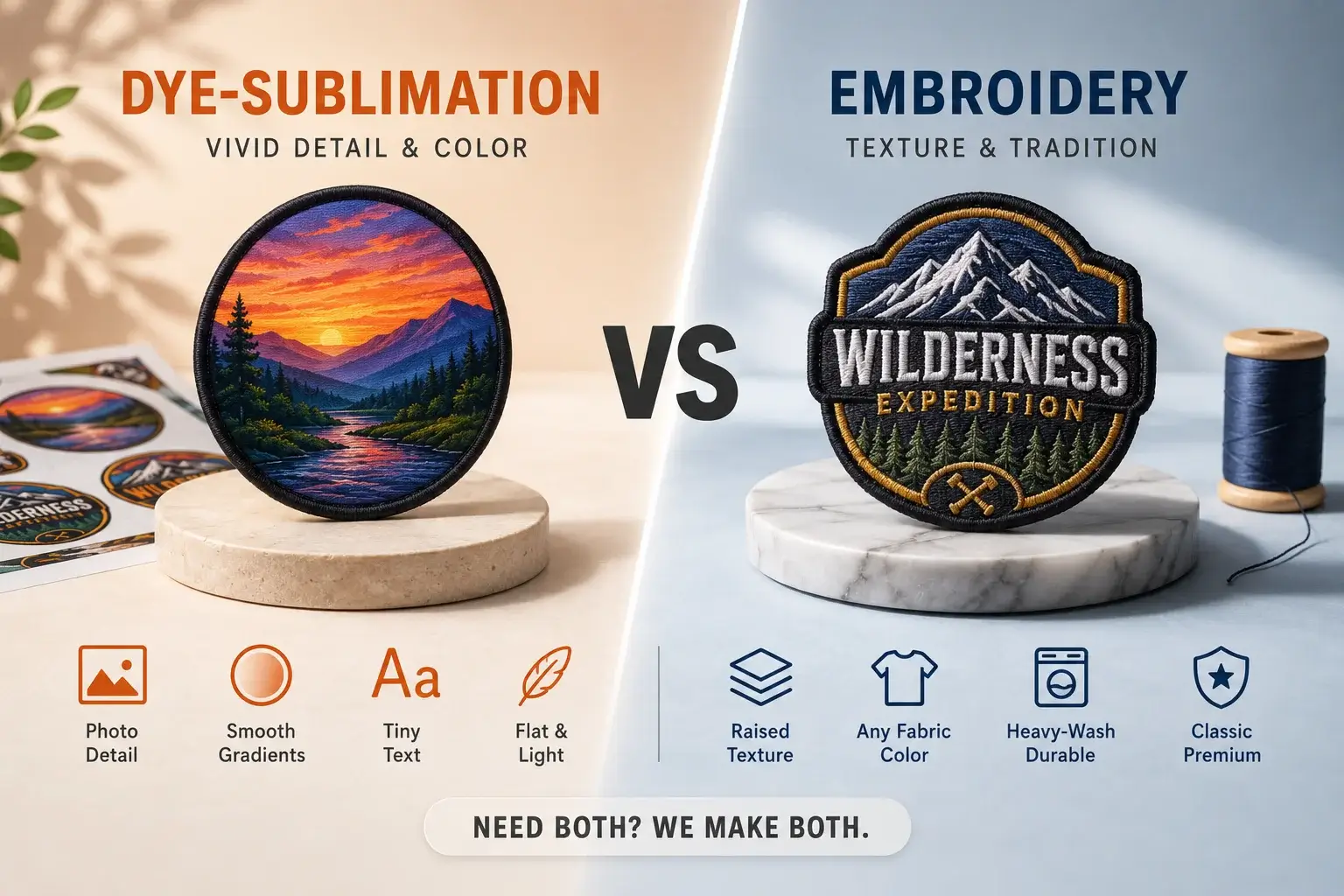
For fine detail, dye sublimation patches win. Sublimation prints dye straight into polyester, so photos, gradients, and tiny text stay razor-sharp with no thread-count limit. Embroidery caps detail at stitch density, so text under about 4mm and smooth shading get lost — but it adds a raised, premium texture. Pick by what your artwork needs.
Here's a fact that surprises people. The same colorful design can be the most expensive patch as embroidery — and the cheapest one as a dye sublimation patch. Same art. Opposite price.
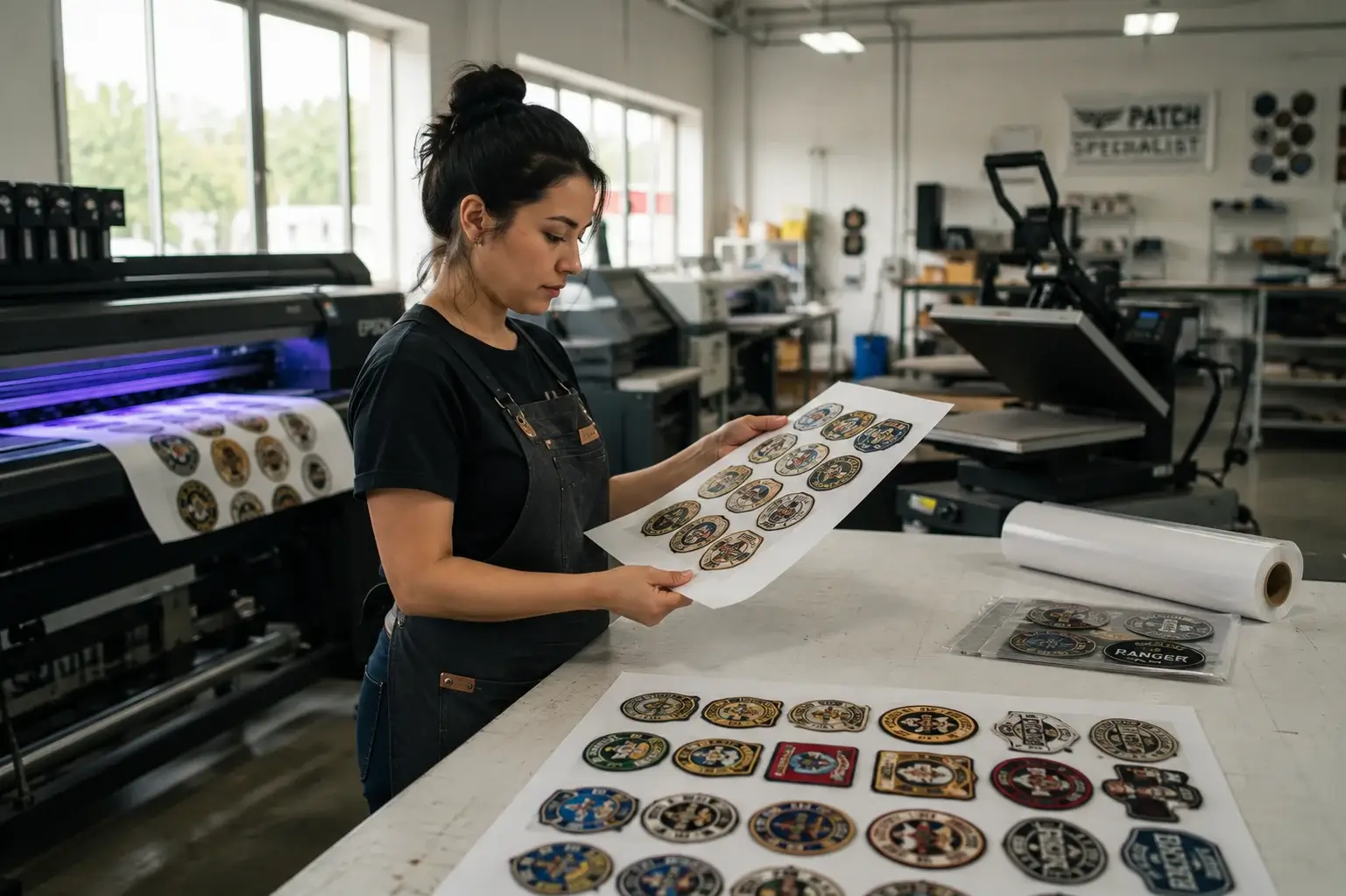
I'm William. I've spent years on the factory floor at Patch Specialist watching both run side by side. The question clients ask most: which holds detail better? The honest answer isn't "this one wins." It's "what does your artwork need?"
A gradient sunset and a bold varsity letter want two different things. Let me show you exactly which is which.
Just last month we ran a client’s memorial portrait as sublimation and their team logo as embroidery in the same order. Same box, two totally different jobs. That’s the reality on our floor most days.
What Are Dye-Sublimation Patches?
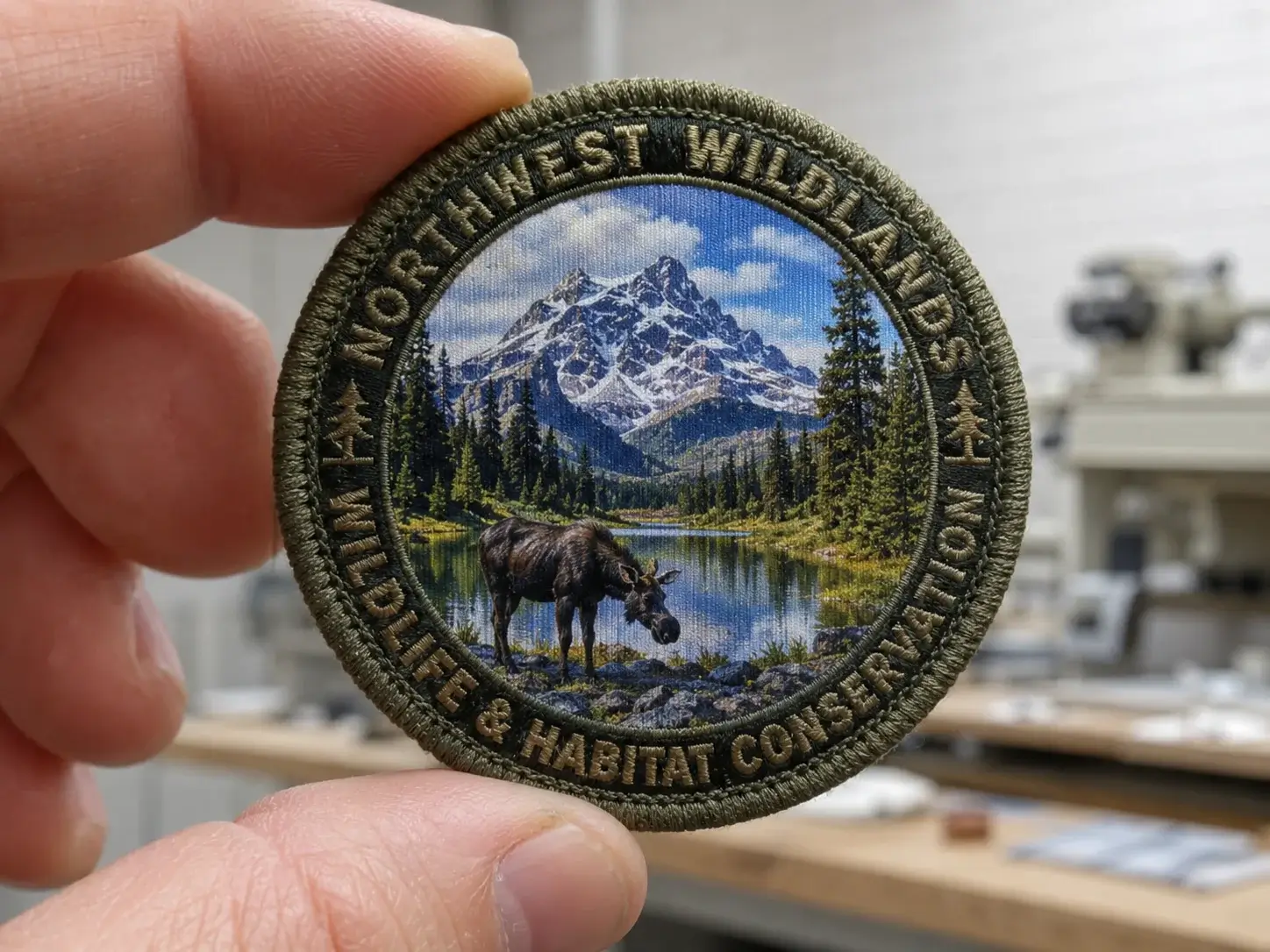
Dye sublimation patches work like baking a design into the fabric. We print your art with dye inks, then heat turns that ink to gas that bonds inside the polyester. The color becomes the material.
Because a printer draws it, there's no minimum thread count and no ceiling on resolution. If a printer can render it, the patch can hold it. That's polyester patch printing.
- Photo-quality detail — gradients, fine lines, and small text reproduce cleanly.
- Flat and light — sits level with the fabric, no bulky raised layer.
- Fused, not on top — the design is fused into the polyester fibers; holds color 50+ washes.
Want to see the range side by side? Explore All Printed Patches to compare styles for your artwork.
How We Make One
- Prep the art as a 300 DPI or vector file.
- Print to transfer paper with dye inks.
- Place it on a light poly base.
- Heat-press so the ink fuses into the fibers.
- Cool, cut, and add the merrow border.
The Heat-Press Window
Temperature is the whole ballgame. Too low and the dye never bonds (early fading). Too high and it scorches. Nailing that window is what makes a patch last years instead of dulling in a month.
Your File Is the Ceiling
Sublimation prints your file exactly as-is. A crisp 300 DPI or vector file comes out razor-sharp. A low-res logo prints soft, no matter how good the machine. Send good art, get unbeatable results.
Where Embroidery Still Wins
Let me be fair to thread. Embroidery gives you texture and dimension you can feel — raised, premium, classic. Think varsity jackets and heritage logos.
We still send out thousands of embroidered patches for uniform contracts every season — when a buyer wants that stitched, built-to-last feel, nothing else comes close.
- Works on any fabric color, even dark bases (sublimation needs a light base).
- Extremely durable in heavy industrial washing.
So for bold, simple logos, embroidery is often the better pick. The catch shows up when the design gets detailed.
The Detail Face-Off
Here's an angle almost no blog states: choose by viewing distance.
Embroidery's raised thread catches light, so it pops from a distance. Sublimation shines up close — fine detail, gradients, and tiny text stay sharp in the hand.
See our full Detail Comparison: Sublimation vs Embroidery to match the method to your design.
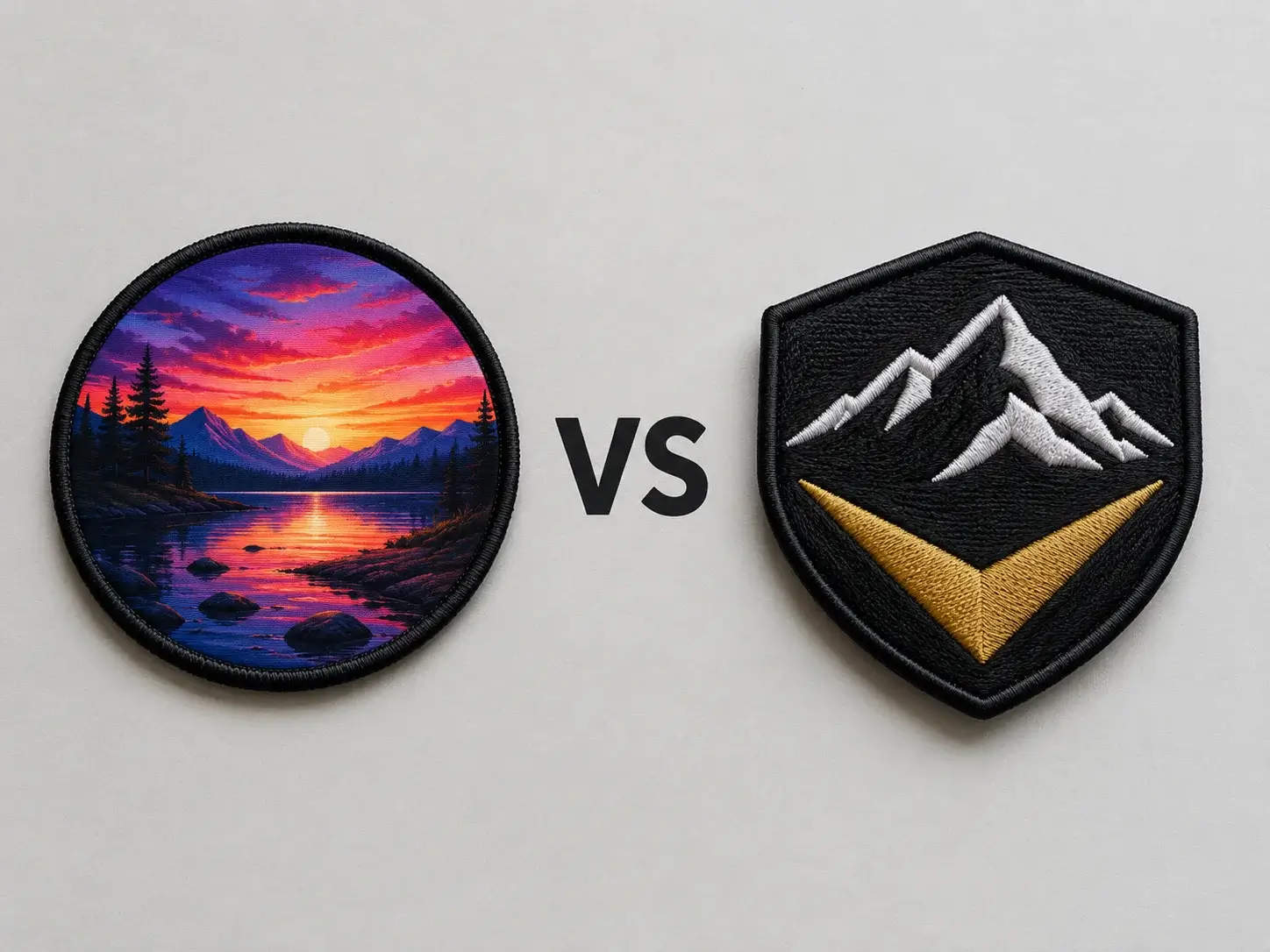
- Small text: embroidery struggles under ~4–5mm; sublimation prints it clean.
- Gradients: embroidery uses solid blocks; sublimation blends smoothly.
- Photos: embroidery simplifies them; sublimation gives true photo realistic patches — see examples of Photo Realistic Patch Artwork.
The Fraying Difference
Embroidered thread can snag or loosen over years. A sublimation patch has no thread in the design to fray — a quiet but real durability edge for detailed art.
The Cost Secret Nobody Explains
In embroidery, more colors = more money.
In sublimation, adding more colors usually does not increase the printing cost.
A 50-color photo costs the same as a 2-color logo.
So complexity moves price in opposite directions.
The design that's priciest to embroider is often the cheapest to sublimate.
Quantity — not color — is the real driver for full color patches.
Rough 2026 Pricing
- 25–50 pieces: ~$2.50–$8 each
- 100+ pieces: ~$1.50–$4 each
- 500+ pieces: ~$1–$2.50 each
- 1,000+ pieces: ~$0.75–$1.50 each
The Hidden Setup-Fee Gap
Embroidery usually carries a $40–$100 digitizing fee. Sublimation usually doesn't. On a small run of a complex design, that gap alone can make embroidery cost nearly double.
Not sure which fits your art?
Send us your design and we'll tell you straight. Free quote and a mock-up in 24 hours at PatchSpecialist.com.
Comparison Table
| Factor | Dye-Sublimation | Traditional Embroidery |
|---|---|---|
| Fine detail & text | Excellent | Limited (~4–5mm min) |
| Gradients & shading | Unlimited | Solid blocks only |
| Photo-realism | Yes | No — simplified |
| Color count | Unlimited, no upcharge | Limited (~8–12) |
| Texture | Flat, smooth | Raised, tactile |
| Durability | Fused into fibers | Very strong |
| Best fabric | Light polyester | Any, incl. dark |
| Setup fee | Usually none | ~$40–$100 |
| Colorful art cost | Cheapest | More expensive |
| Best for | Complex, colorful | Bold, simple logos |
The Print & Stitch Hybrid Option
Our "Print & Stitch" hybrid puts a full-color sublimated base under embroidered borders and accents.
You get photo detail and raised texture in one patch — solving the biggest limit of each method.
Most buyers have never heard of it.
Now you have.
Which Should You Choose?
- Detailed, colorful, or photo art → Sublimation.
- Bold logo you want to feel → Embroidery.
- Dark base fabric → Embroidery.
- Activewear or light fabric → Sublimation (thin, flexible).
- Need identical reorders → Sublimation (printed from one file).
- Want detail and texture → Print & Stitch.
Care Tips
- Wash cold, gentle cycle.
- Skip high-heat drying — air-dry or low heat.
- Never iron directly on the patch.
- No bleach — mild detergent only.
Pro-Tip
Keep the heat low after production. The design was locked in with heat, so more heat is the only thing that can undo it.
Conclusion
So, which has better detail?
For fine lines, gradients, photos, and complex artwork, dye sublimation patches are usually the better choice — especially when detail matters.
For bold logos and dark fabrics, embroidery still earns its place.
And when you want both, Print & Stitch delivers.
Don't ask which is "best."
Ask what your artwork needs, where it'll be seen, and how many you need.
Answer those three and the right patch picks itself.
Ready to see your design come to life?
Start your free quote today at Patch Specialist — mock-up in 24 hours or less.